The Gut Microbiome and the Impact of Fresh Food: A 6-Month Feeding Trial with Ollie Fresh Chicken
Catherine Carchedi, DVM, MS
Lindsay Cassibry, MPH, DVM
Brittany White, PhD
Abstract
The gut microbiome plays a pivotal role in canine health, influencing digestion, immunity, metabolism, and even behavior. Diet is one of the most important factors shaping the composition and function of the gut microbiome. To assess how fresh food affects digestive health and microbial diversity, Ollie conducted a six-month feeding trial comparing the effects of an Ollie fresh diet to a conventional kibble diet on the canine gut microbiome. Results from 16 dogs demonstrated that while both diets supported overall microbial diversity, the Ollie diet produced distinct microbiome profiles enriched in beneficial bacterial taxa associated with short-chain fatty acid production and healthy bile acid metabolism. These findings highlight the potential of fresh, minimally processed diets to support a balanced and functional gut ecosystem in dogs.
Introduction
The canine gastrointestinal tract is home to trillions of microorganisms that collectively form the gut microbiome—a dynamic ecosystem essential to digestion, immune defense, and nutrient absorption. Growing evidence underscores the microbiome’s sensitivity to diet composition and processing level (Rojas et al., 2024; Suchodolski et al., 2012). Diets rich in fresh, whole ingredients may promote a more balanced microbial community, favoring beneficial taxa over potentially pathogenic species.
To evaluate how a fresh diet influences the microbiome, Ollie conducted a six-month feeding trial comparing the microbial profiles of dogs fed an Ollie fresh diet with those consuming a traditional kibble diet. The study aimed to characterize microbiome composition, diversity, and the abundance of beneficial bacterial species over time.
Study Design
Participants and Diets
Sixteen healthy dogs were enrolled in the study. All dogs were initially fed a standard kibble (MFA Gold-N Pro) for the baseline phase, after which they were randomized to either Ollie Chicken Dish with Carrots or a premium kibble (Control) diet for six months (n = 8 per group).
Fecal samples were collected at four time points: baseline, and after 1, 3, and 6 months on the assigned diets. Samples were analyzed by AnimalBiome using PacBio full-length 16S rRNA sequencing.
Sequencing and Analysis
All samples were successfully sequenced, averaging 5,888 reads per sample. Microbiome composition, diversity (alpha- and beta-diversity), and differential abundance were evaluated across timepoints and between diet groups using Wilcoxon tests and PERMANOVA analyses.
Results
1. Microbiome Composition
At baseline, both groups displayed similar microbial communities dominated by Romboutsia, Turicibacter, Peptoclostridium, Ligilactobacillus, Clostridium, and Bacteroides. After transitioning to their respective diets, both groups exhibited shifts in gut microbial composition.
By the first month, dogs fed the Ollie diet showed greater relative abundances of Bacteroides, Streptococcus, and Clostridium, and lower levels of Prevotella and Catenibacterium compared to those fed kibble. These compositional differences became more pronounced by month three and persisted through month six.
2. Alpha-Diversity
Alpha-diversity metrics (Shannon, Pielou’s Evenness) revealed that both diet groups experienced increases in microbial diversity after transitioning from the baseline kibble, indicating that both diets improved microbiome richness and evenness relative to the pre-trial diet.
No statistically significant differences were detected between Ollie and kibble at any timepoint (p > 0.05). However, dogs fed the Ollie diet demonstrated slightly greater evenness at month six (Pielou’s 0.68 vs. 0.65; Shannon 2.62 vs. 2.5), suggesting a more balanced microbial ecosystem that might reach significance with a larger sample size.
3. Beta-Diversity
Beta-diversity analyses revealed that diet was a significant driver of microbiome composition. At baseline, no differences existed between groups (PERMANOVA Aitchison R² = 0.06, p = 0.55). By month one, microbiomes began to diverge (R² = 0.14, p = 0.01), and by month three, nearly 20% of the variation in microbial composition was attributable to diet (R² = 0.18, p = 0.002). These differences persisted through month six, demonstrating a sustained and diet-specific impact on gut microbial structure.
4. Differential Abundance and Key Taxa
At the species level, distinct bacterial signatures emerged between the two diet groups:
Ollie-Enriched Taxa:
Romboutsia ilealis, Clostridium dakarense, Turicibacter sanguinis, Fusobacterium spp., Clostridium hiranonis, and Lactobacillus animalis.
Kibble-Enriched Taxa:
Prevotella copri, Catenibacterium mitsuokai, Bifidobacterium pullorum, and Holdemanella biformis.
While Escherichia coli and Clostridium perfringens increased in the Ollie group, these taxa were present at low levels and are considered part of the normal canine core microbiome (Rojas et al., 2024). Their presence may reflect natural dietary adaptation rather than pathogenic imbalance.
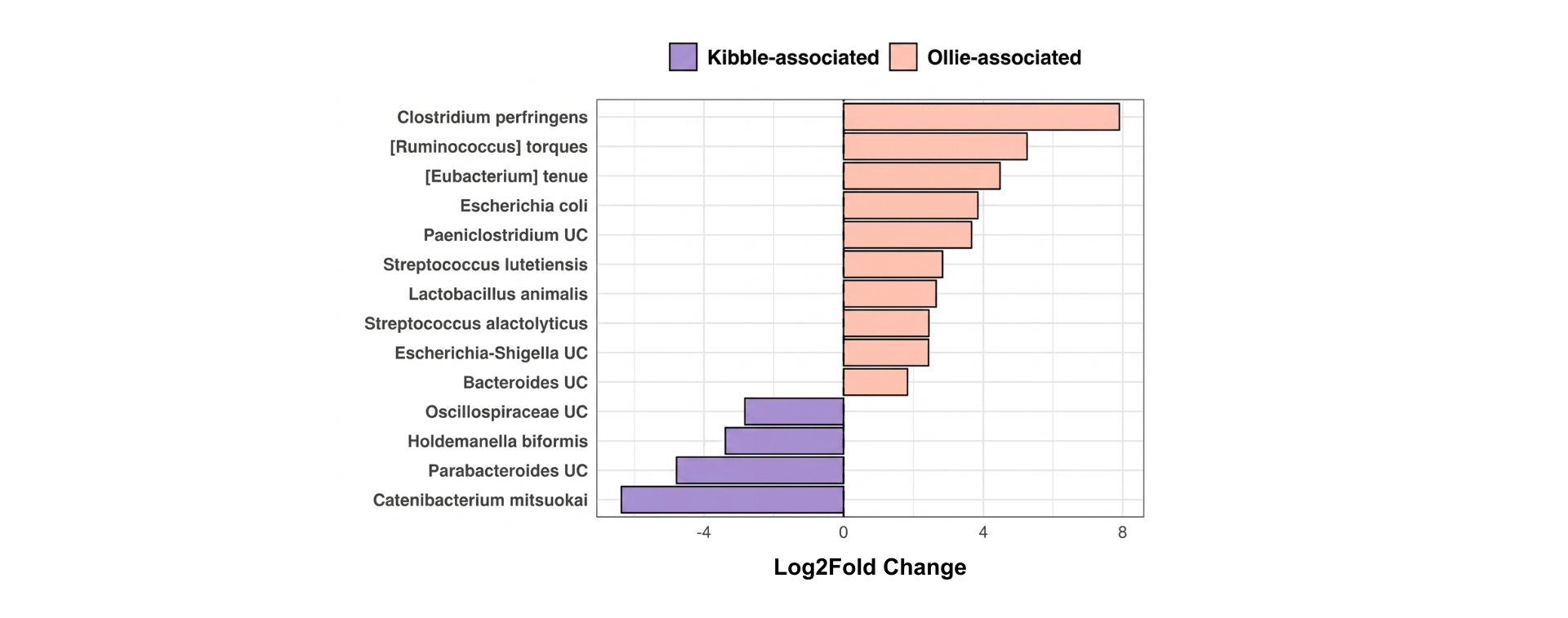 Bacterial species enriched in the microbiomes of dogs fed an Ollie diet vs. a kibble diet, 6 months post diet-transition. Results from LinDA differential abundance analyses performed at the level of bacterial species.
5. Short-Chain Fatty Acids (SCFAs)
Short-chain fatty acid analysis showed some changes over the course of the study, with a few differences between diet groups.
Dogs fed the Ollie fresh diet had higher levels of butyric acid by the end of the study compared to those fed kibble.
Valeric acid levels changed over time in the kibble group, increasing at the midpoint of the study and then decreasing again by the end, while remaining relatively stable in the fresh diet group.
Propionic acid increased over time in both groups, regardless of diet.
Overall, while some differences were observed, changes in SCFAs between the two diets were relatively modest.
Discussion
The Ollie diet resulted in microbiome compositions distinct from those of dogs fed kibble, reinforcing the role of diet composition and processing level in shaping gut microbial communities. Several taxa enriched in the Ollie group—including Turicibacter sanguinis, Romboutsia spp., Clostridium hiranonis, Lactobacillus animalis, and Fusobacterium spp.—are associated with beneficial metabolic functions such as short-chain fatty acid (SCFA) production, bile acid transformation, and mucosal immune support.
Consistent with these taxonomic shifts, dogs fed the fresh diet exhibited increased butyric acid concentrations. Butyrate is a key SCFA that supports colonocyte energy metabolism, gut barrier integrity, and anti-inflammatory signaling. However, despite this increase, broader SCFA changes were modest, with limited differences observed between diet groups overall. This suggests that while microbial composition shifted toward taxa capable of SCFA production, functional outputs may require longer durations, larger sample sizes, or additional dietary substrates (e.g., fermentable fibers) to produce more pronounced metabolic changes.
Importantly, increases in Escherichia coli, Streptococcus, and Clostridium perfringens were observed in the Ollie group. While these taxa are sometimes associated with disease, they are also recognized members of the normal canine gut microbiome. Recent literature, including a 2025 Frontiers in Veterinary Science study evaluating fresh diets, reported similar findings—namely, increases in certain proteolytic bacteria without corresponding increases in dysbiosis index or clinical abnormalities. These authors concluded that such shifts likely reflect dietary macronutrient composition (e.g., higher protein, lower carbohydrate) rather than pathological imbalance.
Similarly, the present study found no evidence of reduced diversity or microbiome instability in the Ollie group. Alpha diversity increased in both diet groups, and beta diversity analyses confirmed stable, diet-driven divergence rather than dysbiosis.
These findings are further supported by other studies comparing fresh, raw, and kibble diets, which consistently demonstrate that less processed, higher-protein diets promote enrichment of taxa involved in protein fermentation and bile acid metabolism, while kibble diets tend to favor carbohydrate-fermenting genera such as Prevotella and Catenibacterium. Together, these patterns suggest that observed microbiome differences are functional adaptations to dietary substrates rather than indicators of compromised gut health.
Taken together, the microbiome and SCFA data indicate that the Ollie fresh diet promotes a distinct and stable microbial ecosystem enriched in metabolically relevant taxa, with functional outputs (e.g., butyrate production) trending in a beneficial direction without evidence of dysbiosis.
Conclusions
This study demonstrates that the Ollie fresh diet exerts measurable and sustained effects on the canine gut microbiome. Dogs fed Ollie developed distinct microbial communities enriched in beneficial, SCFA-producing taxa associated with digestive health and metabolic balance. Although both diets improved diversity relative to the baseline kibble, Ollie’s fresh formulation promoted a unique microbial ecosystem suggestive of enhanced gut function.
These results add to the growing body of evidence that fresh, less processed diets can positively influence gut health and may help maintain a balanced microbiome in companion animals.
References
Doron, L., Coppenhagen-Glazer, S., Ibrahim, Y., Eini, A., Naor, R., Rosen, G., & Bachrach, G. (2014). Identification and characterization of Fusolisin, the Fusobacterium nucleatum autotransporter serine protease. PLOS ONE, 9(10), e111329.
Doulidis, P. G., Galler, A. I., Hausmann, B., Berry, D., Rodríguez-Rojas, A., & Burgener, I. A. (2023). Gut microbiome signatures of Yorkshire Terrier enteropathy during disease and remission. Scientific Reports, 13(1), 4337.
Fan, Z., Ke, X., Jiang, L., Zhang, Z., Yi, M., Liu, Z., Cao, J., Lu, M., & Wang, M. (2024). Genomic and biochemical analysis reveals fermented product of a putative novel Romboutsia species involves the glycometabolism of tilapia. Aquaculture, 581(740483), 740483.
Kitahara, M., Takamine, F., Imamura, T., & Benno, Y. (2001). Clostridium hiranonis sp. nov., a human intestinal bacterium with bile acid 7α-dehydroxylating activity. International Journal of Systematic and Evolutionary Microbiology, 51(1), 39–44.
Moon, A., Sun, Y., Wang, Y., Huang, J., Khan, M. U. Z., & Qiu, H.-J. (2022). Lactic acid bacteria as mucosal immunity enhancers and antivirals through oral delivery. Applied Microbiology, 2(4), 837–854.
Niina, A., Kibe, R., Suzuki, R., Yuchi, Y., Teshima, T., Matsumoto, H., Kataoka, Y., & Koyama, H. (2021). Fecal microbiota transplantation as a new treatment for canine inflammatory bowel disease. Bioscience of Microbiota, Food and Health, 40(2), 98–104.
Phungviwatnikul, T., Alexander, C., Do, S., He, F., Suchodolski, J. S., de Godoy, M. R. C., & Swanson, K. S. (2021). Effects of dietary macronutrient profile on fecal microbiota, fermentative metabolites, and bile acids of female dogs after spay surgery. Journal of Animal Science, 99(9), skab225.
Pilla, R., Gaschen, F. P., Barr, J. W., Olson, E., Honneffer, J., Guard, B. C., Blake, A. B., et al. (2020). Effects of metronidazole on the fecal microbiome and metabolome in healthy dogs. Journal of Veterinary Internal Medicine, 34(5), 1853–1866.
Pilla, R. et al. (2025). [Effects of diet type on the core fecal bacterial taxa and the dysbiosis index of healthy adult dogs] Frontiers in Veterinary Science, 12:1572875.
Rojas, C. A., Entrolezo, Z., Jarett, J. K., Jospin, G., Martin, A., & Ganz, H. H. (2024). Microbiome responses to oral fecal microbiota transplantation in domestic dogs. Veterinary Science in China, 11(1).
Rojas, C. A., Park, B., Scarsella, E., Jospin, G., Entrolezo, Z., Jarett, J. K., Martin, A., & Ganz, H. H. (2024). Species-level characterization of the core microbiome in healthy dogs using full-length 16S rRNA gene sequencing. Frontiers in Veterinary Science, 11, 1405470.
Suchodolski, J. S., Markel, M. E., Garcia-Mazcorro, J. F., Unterer, S., Heilmann, R. M., Dowd, S. E., Kachroo, P., et al. (2012). The fecal microbiome in dogs with acute diarrhea and idiopathic inflammatory bowel disease. PLOS ONE, 7(12), e51907.
Tirloni, E., Cattaneo, P., Ripamonti, B., Agazzi, A., Bersani, C., & Stella, S. (2014). In vitro evaluation of Lactobacillus animalis SB310, Lactobacillus paracasei SB137 and their mixtures as bioprotective agents for raw meat. Food Control, 41, 63–68.
Xu, J., Becker, A. A. M. J., Luo, Y., Zhang, W., Ge, B., Leng, C., Wang, G., et al. (2021). The fecal microbiota of dogs switching to a raw diet only partially converges to that of wolves. Frontiers in Microbiology, 12, 701439.
Yin, H., Huang, J., Guo, X., Xia, J., & Hu, M. (2023). Romboutsia lituseburensis supplementation ameliorates endothelial function via gut microbiota modulation and lipid metabolism. FEMS Microbiology Letters, 370, fnad016.